How to Reverse Sear Steak
Tested in a Real Home Kitchen
Every technique in this guide was tested on a home gas stove using a 10-inch cast iron pan. Results, temperatures, and timings reflect what actually happened — not what should happen in theory.
If you regularly cook steaks thicker than 1.25 inches, the reverse sear will produce a better result than traditional pan-searing almost every time. Not slightly better — meaningfully better, in a way that's immediately obvious when you cut into the steak. The reason is physics, and once you understand it, you'll understand why the method works so well.
Why Traditional Searing Creates a Gray Band
Traditional high-heat searing cooks the steak from the outside in. The exterior reaches searing temperature (280°F+) almost immediately. But heat conducts slowly through beef — so while the outer 1/4 inch is at 300°F, the center might still be at 60°F. To bring the center to 130°F, you have to keep applying heat to the exterior. By the time the center reaches temperature, the outer layer is well past it. That's the gray band.
The reverse sear eliminates this by cooking the interior first. At 225°F oven temperature, heat conducts slowly and evenly through the entire steak. Every part of the steak rises in temperature together. When the center reaches 115°F (for a medium-rare target of 130°F), the entire steak is at roughly that temperature — there's no gradient. The final sear then only needs 45–60 seconds per side to develop a crust, because the surface is completely dry from the oven time and the pan can do its work instantly.
Pro Tips
- Always preheat your pan for at least 2 minutes on high before the steak goes in — not medium-high, high.
- Pat the steak completely dry immediately before cooking, even if you dry-brined it overnight.
- Pull the steak 5°F below your target temperature and let carryover cooking cover the gap during rest.
- Use a heavy-bottomed pan — thin pans lose temperature when the cold steak hits them and you lose the crust.
- Rest on a wire rack, not a cutting board — the board traps steam under the steak and softens the crust.
The First Time I Used This Method
I was skeptical. Putting a raw steak in a 225°F oven seemed counterintuitive — it's barely above the temperature at which harmful bacteria multiply rapidly. But 225°F is well above the danger zone (40–140°F), and the steak reaches safe temperatures in the process of reaching its target internal temperature.
The result on my first attempt was edge-to-edge pink, no gray band at all, with a crust that formed in under 60 seconds per side because the surface was bone-dry from the oven. I've used the method for thick steaks ever since. The consistency is what convinced me — I can repeat the same result reliably in a way that's harder to achieve with traditional searing.
Step-by-Step
- 1
Why Reverse Sear Beats Traditional Searing for Thick Steaks
Traditional searing of a thick steak creates a gradient: a well-cooked outer band and a smaller perfectly cooked center. The reverse sear eliminates this gradient by cooking the entire steak to the target temperature first in a low oven, then developing the crust in a brief high-heat sear. The result is edge-to-edge even doneness with a superior crust — because the completely dry oven-roasted surface forms a crust almost instantly.
- 2
Oven Temperature and Setup
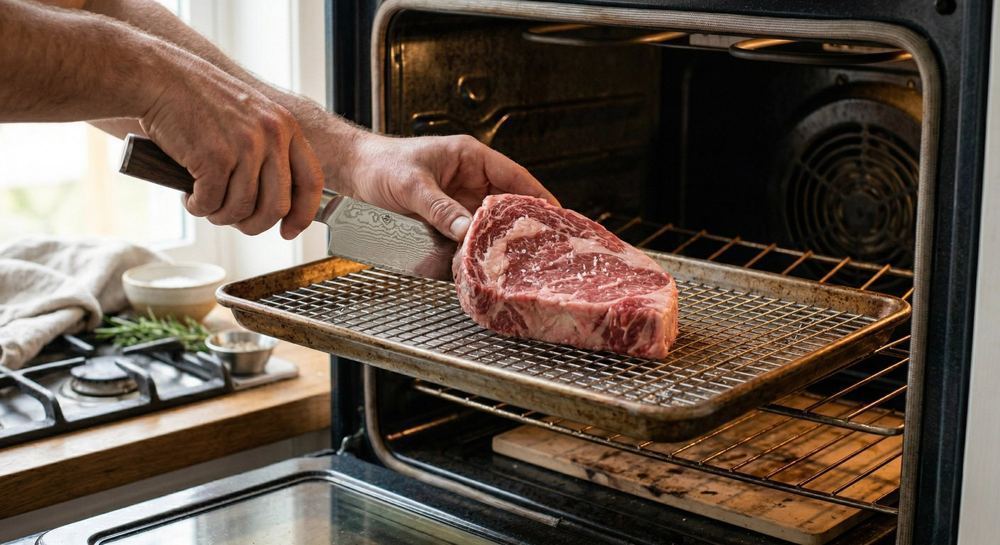
Preheat your oven to 225-250 degrees F. Place the steak on a wire rack over a sheet pan, which allows air to circulate under the steak and prevents the bottom from steaming. Season the steak generously with salt and pepper before going into the oven. A digital leave-in probe thermometer is ideal here — you can monitor the temperature without opening the oven.
- 3
Target Pull Temperature for the Oven Phase
Pull the steak from the oven when it reaches 115-120 degrees F for medium-rare. The oven phase will take 25-50 minutes depending on thickness. While the steak is in the oven, preheat your cast iron skillet over the highest heat your stovetop can produce. By the time the steak comes out, the pan should be smoking.
- 4
The Final Sear — 45 Seconds Per Side
Add a thin coat of high-smoke-point oil to the smoking pan and sear the steak for 45-60 seconds per side. You are not cooking the interior — it is already at temperature. You are developing the Maillard reaction crust as fast as possible. Sear the edges by holding the steak on its side with tongs. The completely dry surface produces a dramatically better crust than a traditionally seared steak.
- 5
Rest Is Minimal — Here Is Why
The reverse sear requires almost no resting time. Because the steak cooked so slowly and evenly, the temperature gradient between edge and center is minimal. A brief 5-minute rest is sufficient, compared to the 7-10 minutes required after traditional searing. This is one of the method's underrated advantages — you can plate and serve faster.
Common Mistakes
The most common mistakes with this technique — and why each one produces a bad result:
- Not drying the surface: Wet steak steams before it sears. The first 30–60 seconds in the pan are wasted evaporating moisture instead of building the Maillard crust. Always pat dry immediately before cooking.
- Pan not hot enough: The most common mistake. If you don't hear an immediate, aggressive sizzle the moment the steak hits the pan, remove the steak and heat the pan longer. A tepid pan means no crust.
- Moving the steak too early: The steak sticks initially because proteins are bonding with the metal. Leave it alone — it will release naturally when the crust is formed. If you force it, the crust tears.
- Cutting before resting: A steak cut immediately after cooking loses 30–35% of its moisture onto the board. A rested steak loses under 10%. The rest period is not optional.
- Cooking straight from the fridge: A cold steak means the outside overcooks before the center reaches temperature. Take steak out 20–30 minutes before cooking.
The Simplified Version for a First Attempt
Set your oven to 250°F. Put your steak (at least 1.25 inches thick) on a wire rack over a sheet pan. Season it. Put it in the oven and check the internal temperature at 20 minutes, then every 5 minutes. When it hits 115°F (for medium-rare), take it out. Rest it for 5 minutes on the counter while you get a cast iron pan screaming hot on your highest burner. Sear for 45 seconds per side. Done.
The Advantage Nobody Talks About
The reverse sear requires almost no resting time after the final sear — 3–5 minutes is enough. Traditional searing requires 7–10 minutes of resting because the exterior is much hotter than the center and the heat needs time to distribute. With the reverse sear, the temperature difference between the edge and center at the end of cooking is minimal. You can serve it faster. For a dinner party, this matters.
Method Comparison
| Method / Type | Key Difference |
|---|---|
| Cast iron pan | Best heat retention, produces the best crust. Gets extremely hot and stays hot when cold steak hits it. |
| Stainless steel pan | Easier to make pan sauces in — more reactive to heat changes. Requires a bit more oil. |
| Grill | Adds smoke and char. Harder to control doneness. Best for thinner steaks. |
| Oven (reverse sear) | Best for thick steaks (1.5 inch+). Most even doneness from edge to edge. |
Step-by-Step: How to Reverse Sear Steak
Pro Tip — The 45-Minute Salt Rule
Salt your steak either immediately before cooking, or at least 45 minutes before. In between 1–44 minutes, the drawn-out moisture sits on the surface and steams the steak instead of searing it. Overnight dry-brining in the fridge gives the absolute best crust.
Steak Doneness Temperature Reference
| Doneness Level | Internal Temp (°F) | Internal Temp (°C) | Visual Description |
|---|---|---|---|
| Rare | 120–125°F | 49–52°C | Bright red center, very soft to touch |
| Medium Rare | 130–135°F | 54–57°C | Warm red center, juicy — chef's recommendation |
| Medium | 140–145°F | 60–63°C | Pink center, slightly firmer texture |
| Medium Well | 150–155°F | 65–68°C | Slightly pink, noticeably less juicy |
| Well Done | 160°F+ | 71°C+ | No pink visible, fully cooked through |
Steak Doneness Visual Guide
Steak Doneness Visual Guide
Rare
120–125°F
Med Rare
130–135°F
Medium
140–145°F
Med Well
150–155°F
Well Done
160°F+
Common Mistakes to Avoid
Even experienced cooks make consistent mistakes with this technique. Understanding them upfront saves hours of trial and error:
- Wrong temperature: Cooking at the wrong heat level — usually too low when browning is the goal — is the single most common error.
- Skipping prep steps: Steps like drying the surface, salting in advance, or bringing food to room temperature are easy to skip and dramatically affect the result.
- Guessing instead of measuring: An instant-read thermometer removes all guesswork. Professional kitchens rely on thermometers, not timing, for every protein.
- Rushing the process: Most techniques have non-negotiable waiting periods — rest times, brining windows, reducing steps. Patience is a cooking skill.
Frequently Asked Questions
Medium rare steak should reach 130–135°F (54–57°C) internally. Remove from heat at 128–130°F as carryover cooking during the rest period will bring it to the ideal temperature.
Rest steak for a minimum of 5 minutes for thin cuts and up to 10 minutes for thick steaks over 1.5 inches. The rest allows juices to redistribute. Tent loosely with foil to keep it warm.
Professional chefs typically oil the pan, not the steak. Adding a small amount of high-smoke-point oil to a very hot pan gives better control. For grilling, oiling the steak directly also works.
Steak sticking is almost always a heat issue. The pan needs to be hot enough that the Maillard reaction happens immediately on contact — creating a crust that naturally releases from the surface.
Key Takeaways
- Always dry your steak surface before searing — moisture prevents browning
- Salt at least 45 minutes before cooking, or just before cooking — never in between
- Use a cast iron or stainless steel pan, never nonstick, for proper crust development
- Rest your steak for at least 5 minutes before slicing to retain all the juices