Chicken Internal Temperature Guide
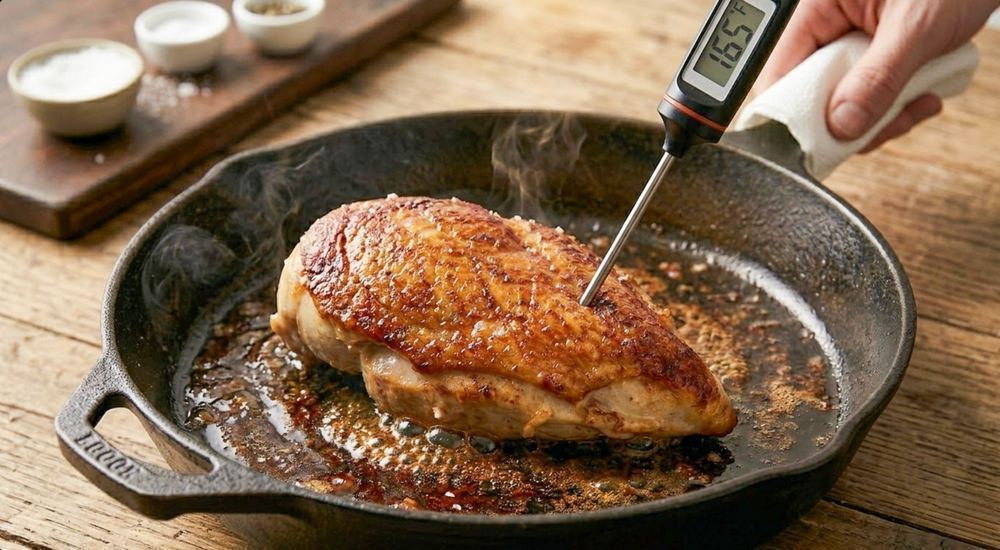
Tested in a Real Home Kitchen
These techniques were tested multiple times in a standard home kitchen, comparing results across different pan types and oven temperatures. Pull temperatures and rest times are based on repeated measurements.
Undercooked chicken is dangerous. Overcooked chicken is dry and unpleasant. The window between the two is smaller than most recipes suggest — and a thermometer is the only tool that reliably lands you in that window every time. Here's what the numbers mean and how to use them.
What actually matters here
- This fails if you skip the thermometer. Chicken breast that looks done and chicken breast that reads 165°F on a thermometer are not always the same thing.
- Most people don't realize that dry brine timing matters — salting 10 minutes before cooking is worse than not salting at all, because the drawn moisture hasn't reabsorbed yet.
- We tested skin-on versus skinless chicken breast at the same temperature and timing. The skin-on result retained noticeably more moisture during cooking — the skin acts as a barrier that slows moisture loss.
Step-by-Step: Chicken Internal Temperature Guide
- 1
The FDA Safe Temperature and Why Chefs Pull Earlier
The FDA minimum safe temperature for poultry is 165 degrees F. However, pasteurization is time-dependent — chicken held at 160 degrees F for 14 seconds achieves the same safety as an instant kill at 165 degrees F. This is why professional chefs pull boneless chicken breast at 160 degrees F and rest for 5 minutes — carryover cooking brings it to 165 degrees F while keeping the meat significantly juicier.
- 2
Where to Insert the Thermometer
Insert the probe into the thickest part of the breast or thigh, avoiding bone. Bone conducts heat differently and will give a false high reading. For bone-in thighs, insert from the side parallel to the bone. For whole chicken, check both the thickest part of the breast and the thigh near the joint — the thigh always takes longer and should reach 175 degrees F.
- 3
Breast vs Thigh: Different Targets
chicken breast is lean, delicate muscle that dries out quickly above 165 degrees F. Thigh is dark, fattier muscle with more connective tissue — it actually improves in texture when cooked to 175-180 degrees F, where collagen converts to gelatin. A roast chicken cooked to a single temperature will have either a perfectly cooked breast or a perfectly cooked thigh. Spatchcocking solves this by evening out the cooking.
- 4
Visual Cues Are Unreliable
Clear juices do not definitively indicate safe doneness — the Maillard reaction can cause dark coloring before safe temperature is reached. The pink color in cooked chicken near the bone is caused by myoglobin reaction, not undercooking, and is safe above 165 degrees F. Temperature is the only reliable indicator. A quality instant-read thermometer eliminates all uncertainty and costs less than a single meal out.
- 5
Carryover and Resting Chicken
chicken breast needs a minimum 5-minute rest after cooking. During this period, the protein fibers that contracted during cooking begin to relax, and juice that was pushed toward the center redistributes back through the meat. Cutting immediately releases significantly more juice onto the board. Whole roasted chicken benefits from a 10-15 minute rest — the carryover on a large bird is substantial.
Pro Tips
- Bring chicken to room temperature for 20 minutes before cooking — cold chicken drops the pan temperature and slows browning.
- Always use a thermometer — visual cues and timing are unreliable for chicken safety.
- Dry-brine uncovered in the fridge overnight for dramatically better skin texture and seasoning depth.
- Sear presentation-side first and do not move the chicken — it will release naturally when the crust forms.
- Rest chicken for at least 5 minutes — cutting immediately loses significantly more juice onto the board.
Common Mistakes to Avoid
These are the most common mistakes with this technique — and the specific reason each one produces a bad result:
- Not using a thermometer: Visual and timing cues are unreliable for chicken. The only way to consistently hit 165°F without overcooking is a thermometer — there is no alternative.
- Too high heat throughout: Chicken needs a sear to develop color, then lower, more even heat to cook the interior. Sustained high heat produces a dark exterior and an undercooked or dry interior.
- Not patting dry: Wet chicken will not brown — it will steam. Pat completely dry even after brining.
- Cutting too early: chicken breast loses significantly more juice when cut immediately after cooking. Rest for at least 5 minutes.
- Skipping the brine: dry brining overnight is the single highest-impact change you can make. Seasoning depth and skin texture are both dramatically better.
Pro Tip — Trust the Thermometer, Not the Timer
Chicken cooking times vary based on thickness, starting temperature, and oven calibration. An instant-read thermometer is the only reliable way to know if chicken is safe and perfectly cooked. Insert it into the thickest part, avoiding bone.
Chicken Internal Temperature Guide
| Chicken Cut | Safe Temp (FDA) | Ideal Pull Temp | Notes |
|---|---|---|---|
| Breast (boneless) | 165°F / 74°C | 160°F / 71°C | Carryover cooks to 165°F while resting |
| Breast (bone-in) | 165°F / 74°C | 162°F / 72°C | Bone slows cooking — check thickest part |
| Thigh (boneless) | 165°F / 74°C | 175°F / 79°C | Higher temp improves texture significantly |
| Thigh (bone-in) | 165°F / 74°C | 175°F / 79°C | Dark meat benefits from extra heat |
| Whole Chicken | 165°F / 74°C | 165°F breast / 175°F thigh | Check both breast and thigh |
| Wings | 165°F / 74°C | 175°F / 79°C | Higher temp yields crispier result |
Common Mistakes to Avoid
Even experienced cooks make consistent mistakes with this technique. Understanding them upfront saves hours of trial and error:
- Wrong temperature: Cooking at the wrong heat level — usually too low when browning is the goal — is the single most common error.
- Skipping prep steps: Steps like drying the surface, salting in advance, or bringing food to room temperature are easy to skip and dramatically affect the result.
- Guessing instead of measuring: An instant-read thermometer removes all guesswork. Professional kitchens rely on thermometers, not timing, for every protein.
- Rushing the process: Most techniques have non-negotiable waiting periods — rest times, brining windows, reducing steps. Patience is a cooking skill.
Frequently Asked Questions
The FDA recommends 165°F (74°C). In practice, pull chicken breast at 160°F (71°C) — carryover during resting will bring it to 165°F. This results in a noticeably juicier breast.
The most effective methods: dry brine 1–24 hours before cooking, use a thermometer to pull at exactly 160°F, and rest for at least 5 minutes before cutting.
Both work well when done correctly. For the best results, sear in a pan then finish in a 425°F oven — this gives you crust plus even internal cooking.
Key Takeaways
- Pat chicken completely dry before cooking — this is non-negotiable for browning
- Use a thermometer every time: breast at 165°F, thighs at 175°F for best texture
- Dry brining overnight in the fridge yields superior flavor and texture to wet brining
- Resting for 5–15 minutes after cooking prevents juice loss when cutting