How to Make Pan Sauce
Tested in a Real Home Kitchen
Sauces break when you make mistakes — and we made them. The techniques and troubleshooting in this guide come from real kitchen failures and what fixed them.
The best thing that can happen to a pan after you cook in it is that you make a sauce in it. Most home cooks wash it instead. That's the most expensive cooking mistake you can make — those brown bits stuck to the bottom are concentrated Maillard flavor that took you 4 minutes of high heat to create, and they dissolve into liquid in about 15 seconds of deglazing.
Pan sauce is not advanced cooking. It's the most logical continuation of what you already started.
What Fond Is and Why It Matters
When protein hits a very hot pan, the Maillard reaction creates hundreds of flavor compounds at the surface. Some of those compounds dehydrate and bond to the pan surface — that's fond. It's not burnt food. It's concentrated flavor that's waiting for moisture to dissolve it.
When you add wine or stock to a hot pan, the rapid temperature differential causes those compounds to release immediately. A pan with 30 seconds of deglazing contains more flavor than many sauces that took an hour to make from scratch. The key is doing it while the pan is still hot and before the fond carbonizes and actually becomes bitter and unusable.
Pro Tips
- Deglaze immediately after removing protein — fond dissolves easily when the pan is still very hot.
- Taste the sauce at every stage of reduction — it intensifies fast and can become over-seasoned quickly.
- Mount butter off heat only — if the pan is too hot, the emulsion breaks and the sauce turns greasy.
- Strain through a fine mesh sieve for a professional smooth texture — takes 10 seconds.
- Add acid (wine, lemon) at the start of reduction, not at the end — it mellows with cooking time.
What I Noticed Testing Pan Sauces
I made the same pan sauce three ways: deglazing immediately while the pan was screaming hot, waiting 2 minutes after removing the protein, and waiting 5 minutes. The immediate deglaze produced a sauce with significantly more depth and complexity. The 2-minute wait was noticeably less rich. The 5-minute wait produced a sauce that tasted thin and slightly bitter in spots where the fond had started to carbonize.
This confirmed something I'd read but hadn't experienced directly: fond has a shelf life once the heat is off. Deglaze immediately or you're working with degraded material.
Step-by-Step
- 1
Understanding Fond — The Basis of Every Pan Sauce
The brown bits stuck to the bottom of your pan after searing protein are not burnt food — they are the most concentrated Maillard flavor compounds in your kitchen. Called fond (French for foundation), these dehydrated proteins and sugars are the entire point of making a pan sauce. Never wash this away. Every pan sauce begins the moment you remove the protein — with a hot pan, hot fond, and the intent to capture every bit of that flavor.
- 2
Deglaze with the Right Liquid
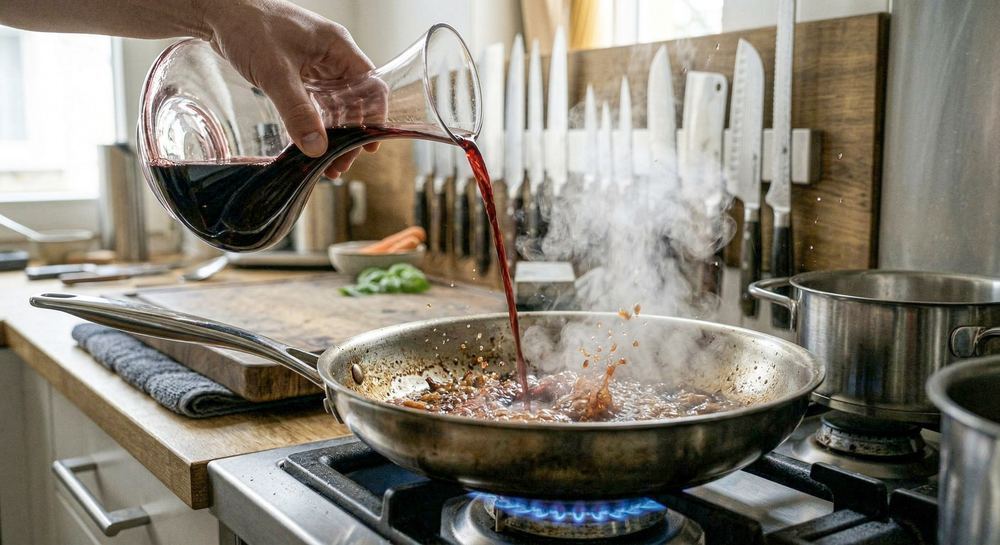
deglazing means adding liquid to a hot pan to dissolve the fond. White wine is the classic choice for chicken and fish. Red wine for beef and lamb. Chicken or beef stock for a deeper neutral base. Always use enough liquid to cover the bottom of the pan by about 1/4 inch. The liquid hits the hot metal, erupts in steam, and the rapid temperature change loosens every bit of fond from the surface.
- 3
Reduce to Concentrate Flavor
After deglazing, let the liquid reduce by approximately half over medium-high heat, scraping any remaining fond from the pan sides. Taste the sauce as it reduces — it should become progressively more savory and complex. Add aromatics now: shallots softened in the pan before deglazing, fresh thyme, a bay leaf. If using wine, reduce until the sharp alcohol smell mellows — about 2-3 minutes.
- 4
Build Richness and Body
After the reduction, add stock to increase volume and add another layer of flavor, then reduce again. To thicken: reduce further, whisk in cold butter (mounting), or add a splash of heavy cream. Each approach produces a different texture and flavor profile. The reduction method gives the most concentrated flavor. Mounted butter adds gloss and richness. Cream adds body and rounds sharp flavors.
- 5
Mount the Butter Off Heat
Remove the pan from direct heat and whisk in cold unsalted butter cut into small cubes, one or two at a time. The butter emulsifies into the sauce — each cube of cold fat dispersing as tiny droplets suspended in the liquid. This adds gloss, richness, and a velvety mouthfeel. If the pan is too hot when you add the butter, it will break and the fat separates. Aim for a sauce temperature around 140-160 degrees F when mounting.
Common Mistakes
The most common mistakes with this technique — and why each one produces a bad result:
- Deglazing with a cold pan: Fond dissolves more easily and completely in a hot pan. deglaze immediately after removing the protein while the pan is still very hot.
- Not tasting as you reduce: A sauce concentrates as it reduces — including salt and acidity. Taste at every stage.
- Mounting butter in a hot pan: If the pan is too hot when you add butter, the emulsion breaks immediately. Work off direct heat.
- Reducing too fast: Rapid reduction at very high heat can scorch the bottom of the pan. Reduce at medium-high, not maximum heat.
- Adding cream too early: Cream scorches easily. Add it after the initial reduction, not at the start.
The 3-Minute Pan Sauce Anyone Can Make
After cooking chicken or steak: don't touch the pan. Add a minced shallot directly to the hot fat, cook 45 seconds. Add 1/3 cup white wine (chicken) or red wine (beef) — it will boil immediately and violently. Scrape up every brown bit. Reduce by half over high heat, about 90 seconds. Add 2 tablespoons cold butter, remove from heat, swirl to melt. Season. Done. That's the whole recipe.
Why I Always Deglaze With Wine Before Stock
Stock-only pan sauces taste flat compared to wine-first sauces. The alcohol in wine does something that water and stock can't — it dissolves fat-soluble flavor compounds that water alone can't lift. The wine reduction that follows concentrates those compounds. By the time you add stock, you already have a base with more complexity than stock alone could provide. The alcohol cooks off in the reduction. What remains is pure flavor.
Method Comparison
| Method / Type | Key Difference |
|---|---|
| White wine | Best for chicken and fish pan sauces. Bright, acidic, dissolves fond well. |
| Red wine | Best for beef and lamb. Richer, deeper flavor after reduction. |
| Stock only | Neutral base. Works with any protein. Reduce more to concentrate flavor. |
| Cream | Adds richness and body. Goes in after reduction, not before — it scorches easily. |
Step-by-Step: How to Make Pan Sauce
Pro Tip — Deglaze Every Pan You Cook Protein In
The browned bits stuck to your pan after cooking steak, chicken, or fish are called 'fond' — they are pure, concentrated flavor. After removing the protein, add wine, stock, or even water to the hot pan, scraping up all the fond. This is the basis of every great pan sauce.
The Five French Mother Sauces
| Mother Sauce | Liquid Base | Thickener | Classic Derivatives |
|---|---|---|---|
| Béchamel | Milk | White roux | Mornay, Nantua, Soubise |
| Velouté | Light stock | Blonde roux | Allemande, Supreme, Bercy |
| Espagnole | Brown stock | Brown roux | Demi-glace, Bordelaise, Chasseur |
| Hollandaise | Clarified butter | Egg yolks | Béarnaise, Maltaise, Choron |
| Sauce Tomat | Tomatoes/stock | Tomatoes | Américaine, Pizzaiola, Portugaise |
Common Mistakes to Avoid
Even experienced cooks make consistent mistakes with this technique. Understanding them upfront saves hours of trial and error:
- Wrong temperature: Cooking at the wrong heat level — usually too low when browning is the goal — is the single most common error.
- Skipping prep steps: Steps like drying the surface, salting in advance, or bringing food to room temperature are easy to skip and dramatically affect the result.
- Guessing instead of measuring: An instant-read thermometer removes all guesswork. Professional kitchens rely on thermometers, not timing, for every protein.
- Rushing the process: Most techniques have non-negotiable waiting periods — rest times, brining windows, reducing steps. Patience is a cooking skill.
Key Takeaways
- Mise en place (prep before you start) is essential for successful sauce making
- Reducing a sauce by half typically doubles its flavor concentration and depth
- Acid (wine, lemon, vinegar) brightens and balances almost any sauce
- Mounting butter off the heat adds gloss, richness, and silkiness to any pan sauce